All Episodes
Displaying 241 - 260 of 340 in total
Key Exchange, Algorithms, Key Length, and Protocol Selection (1.3)
This episode covers how systems agree on encryption keys, choose algorithms, and select protocols without exposing sensitive material directly. Key exchange allows two...
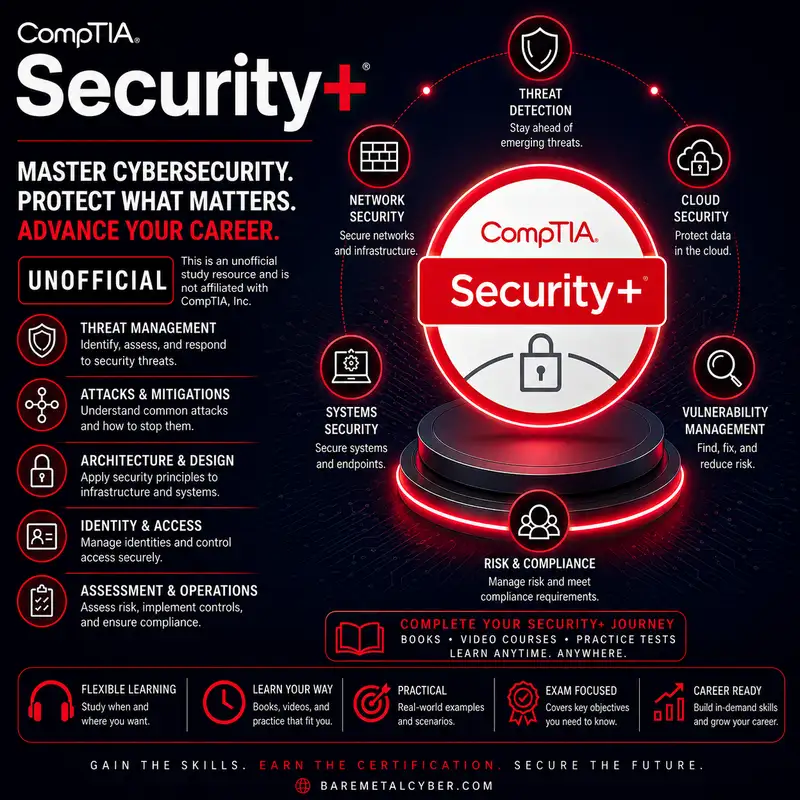
Hashing, Salting, Digital Signatures, Obfuscation, and Crypto Tools (1.3)
This episode explains several cryptographic concepts that are often confused on the exam. Hashing creates a fixed output used to verify integrity, while salting adds u...
Threats vs. Vulnerabilities: Likelihood, Impact, and Life Cycle (2.1)
This episode explains the difference between a threat, a vulnerability, and risk, which is essential for understanding Security+ scenarios. A threat is something that ...
Threat Feeds and Intelligence Sources (2.1)
This episode covers threat feeds and intelligence sources as tools that help security teams understand which threats matter most. Students should recognize sources suc...
Vulnerability Scoring: CVSS, CVEs, and Prioritization (2.1)
This episode explains CVEs and CVSS as common tools for identifying and scoring vulnerabilities. A CVE is a public identifier for a known vulnerability, while CVSS pro...
Vulnerability Types and Risk-Based Decisions (2.1)
This episode covers common vulnerability types across software, configuration, identity, cloud, and operational processes. Students should recognize that vulnerabiliti...
Threat Actors: Organized Crime, Terrorists, Hacktivists, and Insiders (2.2)
This episode introduces major threat actor categories and explains how their goals and behavior differ. Organized crime groups often pursue financial gain through frau...
State-Sponsored, Competitors, Accidental, and Unskilled Attackers (2.2)
This episode explains additional threat actor types, including state-sponsored actors, competitors, accidental users, and unskilled attackers. State-sponsored actors m...
Motivations and Capabilities: Money, Espionage, Ideology, and Extortion (2.2)
This episode connects attacker motivations to tactics, target selection, persistence, and expected impact. Financially motivated attackers may focus on ransomware, pay...
APTs and the Modern Threat Vector Map (2.3)
This episode introduces advanced persistent threats and uses them as a bridge into the broader Security+ threat vector landscape. An advanced persistent threat is typi...
Message-Based Attacks: Email, SMS, RCS, IM, and Collaboration Tools (2.3)
This episode covers message-based attacks delivered through email, SMS, Rich Communication Services, instant messaging, and collaboration platforms. Students should un...
Image and Attachment Attacks: QR Codes, CAPTCHA Abuse, Macros, PDFs, and RTF (2.3)
This episode explains how attackers use familiar images and file types to deliver malicious content or manipulate user trust. QR-code attacks can move users from a pro...
Browser-Based Attacks: Extensions, JavaScript, Cookies, Password Managers, and Session Tokens (2.3)
This episode explains why the browser is a major attack surface in modern environments and how attackers target the tools users rely on every day. Students should unde...
Network, Remote Access, and Endpoint Threat Sources (2.3)
This episode covers threat sources connected to infrastructure devices, virtualized systems, session keys, remote desktop, VNC, VPNs, mobile devices, servers, tablets,...
Supply Chain, SaaS, USB, Human, IoT, OT, Physical, Bluetooth, RF, and NFC Threats (2.3)
This episode explains how attack paths often begin outside an organization’s directly managed systems. Students should understand supply chain risks involving third-pa...
Unsupported, Unpatched, Obsolete, and Unmanaged Systems (2.4)
This episode explains why unsupported, unpatched, obsolete, and unmanaged systems create serious attack surface risk. Unsupported systems may no longer receive securit...
Ports, Services, Applications, Race Conditions, and Malicious Updates (2.4)
This episode covers several common sources of technical exposure, including open ports, unnecessary services, vulnerable applications, race conditions, time-of-check/t...
Code Weaknesses: Hardcoded Secrets and Unsafe Exception Handling (2.4)
This episode explains two code-level weaknesses that frequently create preventable security problems: hardcoded secrets and unsafe exception handling. Hardcoded passwo...
Stale Credentials, Rogue Devices, Shadow IT, Wireless, Mobile, and Identity Provider Risks (2.4)
This episode covers attack surface risks created by unmanaged identities, unmanaged assets, and uncontrolled technology use. Stale credentials remain active after user...
LLMs, Misconfigurations, Public Repositories, and Public Object Storage (2.4)
This episode explains newer and common attack surfaces involving large language models, cloud misconfigurations, exposed repositories, leaked secrets, and public objec...